•
How to Hold an Ocean with Four Hands
Danish & Maitre
14 May 2026 - 11 July 2026
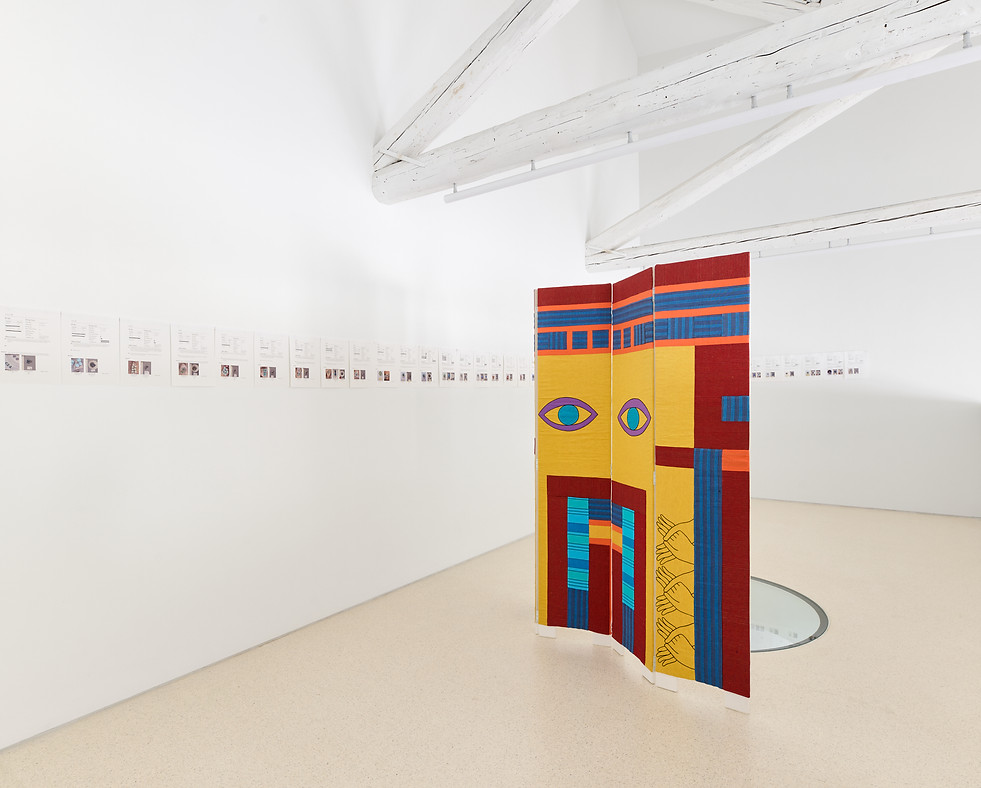
Artopia is delighted to present two solo shows, opening to the public at Via Lazzaro Papi 2, in Milan, from Thursday 14 May to Friday 10 July. On the ground floor, “Simultanea" by Eleanor Ekserdjian, and on the upper floor, “How to Hold An Ocean with Four Hands” by the duo Danish & Maitre.
Though developed independently, the two exhibitions engage in a dialogue across space. The large space running along the length of the floor plan divides the gallery into two floors and, together with other distinctive architectural features, facilitates visual communication between the two levels.
The two exhibition projects, which thus coexist harmoniously within the architectural setting, also reveal similarities from a thematic perspective. Eleanor Ekserdjian, a British artist of Armenian heritage, presents a body of work exploring the layered nature of cultural memory. Through painting, camera-less photography and video, she gives form to what she describes as “simultaneous landscape”, in which the scenery of Armenia and the UK meet and intertwine. From the other, the French duo Danish & Maitre pursue a research project into the traces of an ancient knowledge: Egyptian blue, an emblem of a remote understanding that both withdraws and reveals itself in its aura of mystery. What emerges is an almost initiatory journey, gradually unfolding through a series of clue-like works.
On the ground floor, “Simultanea", the first solo exhibition in Italy by Eleanor Ekserdjian (London, 1996), whose title evokes the core of her artistic practice: a pictorial and filmic approach built upon superimpositions and co-presences. The artist’s practice takes the form of a hybrid language, in which painting, drawing and moving images coexist in a dynamic tension. Through a rapid pictorial gesture, the artist captures and renders traces, evoking a dimension suspended between presence and fading.
Ekserdjian draws from films she has made in Armenia and the UK, subsequently reworked through a process of painterly translation that retains and at the same time transforms their movement. What emerges is a “simultaneous landscape”: spaces where time, place and memory intersect, giving shape to a layered vision under constant redefinition.
Ekserdjian’s practice takes shape as a hybrid language in which painting, drawing, and moving images coexist in a dynamic tension. Through a rapid gesture, the artist records and renders traces, evoking a dimension suspended between presence and dissolution.
Within this same line of research, Ekserdjian’s film Imagined Landscapes represents the first direct experience of a landscape long imagined but never lived, developed from a diasporic perspective tied to the artist’s upbringing in the United Kingdom and her interest in her Armenian family origins. The work articulates this tension through a sequence of fixed shots that present landscapes and medieval monasteries as layered spaces, suspended between historical memory and contemporary urgency, alternately perceived as testimonies of the past and as settings marked by current dynamics of conflict.
On the first floor, the exhibition How to Hold An Ocean with Four Hands by the duo Danish & Maitre opens concurrently. The duo, composed of artists Jean-Baptiste Maitre (1978, France) and Dina Danish (1981, France), have, since 2016, worked together on specific projects alongside their independent practices. The exhibition presents an initial body of works centered on the artists’ research into Egyptian blue, an ancient and almost mythical pigment that emerged at the dawn of history and then gradually disappeared, leaving behind only traces and hypotheses. A true philological reconstruction began four years ago, following a lead without certainty, guided only by clues.
Emblematic is the film Egyptian Blue, How to Forge the Skies and the Seas, which takes the form of both a narrative and hermeneutic device. The film follows the artists on a journey through archives, laboratories, and contemporary landscapes, situating the investigation of the pigment within a broader reflection on different forms of knowledge. Rooted in the principles of experimental archaeology, the work foregrounds a rigorous, process-oriented approach in which historical methods and materials are systematically tested and reactivated. What emerges is a space in which documentation, performance, and scientific reconstruction converge, with a clear emphasis on method, verification, and reproducibility.
In this context, the duo’s practice unfolds as a layered experience of seeing and understanding, in which Egyptian blue becomes the symbol of a material that is at once concrete and historically situated. A material capable of expressing the tension between knowledge and process, between acquired understanding and still-open fields of inquiry.
The exhibitions presented by Artopia thus resonate with one another through their contrasts and affinities. Whilst Ekserdjian explores the role of landscape and architecture in cultural memory, capturing an immediacy of response in the present, Danish & Maitre, with the approach of two archaeologists, reactivate it, bringing it to the surface as a layered experience. The result is a dialogue in which revelation and mystery, the visible and the invisible, coexist and amplify one another. Past and present, memory and matter, intertwine in a shared narrative capable of traversing and connecting the two exhibition levels.


Dina Danish
Dina Danish (1981, Paris, France) holds a BA from the American University in Cairo and an MFA from CCA in San Francisco, and has completed a post-graduate artist residency at the Rijksakademie in Amsterdam in 2010. Her work has been shown in museums and institutions such as MAC/CCB, Lisbon; MAMbo – Museo d’Arte Moderna di Bologna; Stedelijk Museum, Schiedam; Museum Boijmans, Rotterdam; Kunsthall Oslo; SFMOMA, San Francisco; Beirut and Nile Sunset Annex, Cairo; De Nederlandsche Bank and de Appel Arts Centre, Amsterdam; and South London Gallery. She has been nominated for the Volkskrant Prize and the Prix de Rome in the Netherlands and the Abraaj Art Prize in the UAE. Danish is the recipient of the illy Present Future Award at Artissima 18, a Celeste Prize, the Mondriaan Fund, and a Barclay Simpson Award at CCA. Her work is in the collections of MAMbo, SFMOMA, MoMA in New York, the Berkeley Art Museum, the Getty Art Museum in Los Angeles, De Nederlandsche Bank, ABN Amro, Nomas Foundation, and the Texeira de Fritas Collection, among others.
Jean-Baptiste Maitre
Jean-Baptiste Maitre, based in Amsterdam, Paris, and Cairo (b. 1978, France), is an artist whose practice centers on painting while expanding into animation, digitally constructed photography, and ceramics. His work sits at the intersection of image theory and craft in reaction to the post-digital condition. In his recent painting series, Painting as Makeup, Maitre reinterprets ancient painted busts to explore the construction of contemporary identity, following his earlier series, The Telephone is Killing the Cosmos, which examines the intersection of digital technology and traditional still-life techniques. Maitre’s exploration of media extends to his animated films, which dissect cinematic mechanics through the lens of historical or media-found events. In his ceramic work, he reinvents neon signage to question the influence of media and the nature of memory. Maitre was educated in Paris in fine art (ENSBA), archaeology (Michelet-Sorbonne Paris IV), and photography (Gobelins, l’École de l’Image). In the Netherlands, he has participated in prestigious residencies such as the Rijksakademie and the Jan van Eyck Academie, and in Italy at the American Academy in Rome. Maitre has exhibited internationally, with works in major institutional collections, including the Stedelijk Museum, Centre Pompidou, and Sammlung Philara, among others.