•
quasi maturi
Alejandro Almanza Pereda
Gianfranco Baruchello
Alik Cavaliere
Giuseppe De Mattia
Angelo Filomeno
Achille Funi
Piero Gilardi
Ingela Ihrman
Glenda León
Eleonora Mariani
Giorgio Morandi
Marc Quinn
Isabella Ponte
Man Ray
Shimabuku
Sissi
Daniel Spoerri
Giuseppe Urso
Andreas Zampella
curated by Elena Forin
25 July – 23 August 2026
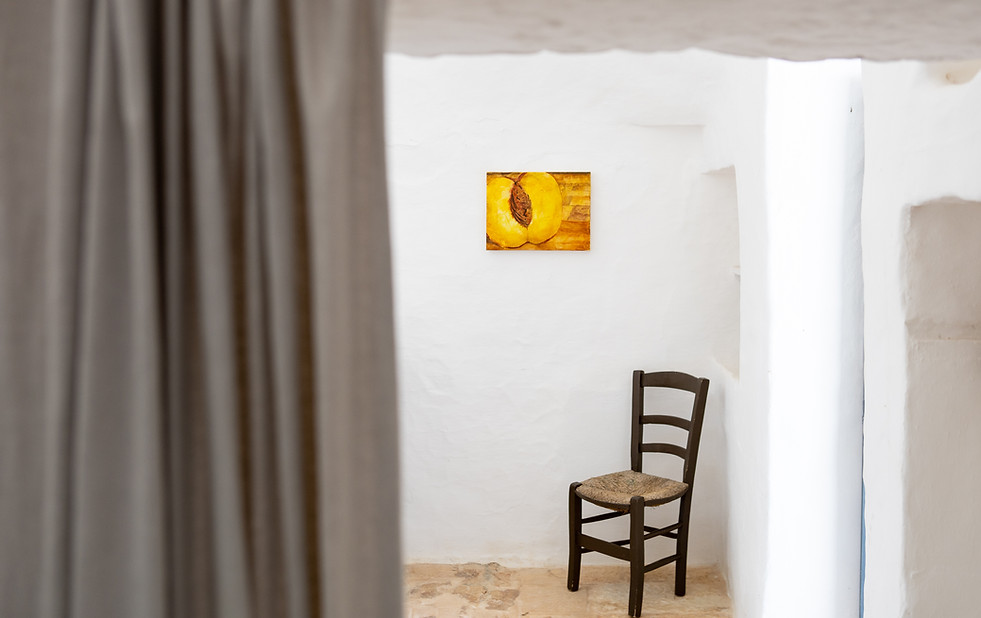
The V edition of Nucré | Rassegna d'arte contemporanea, entitled "Quasi maturi" and curated by Elena Forin, pays tribute to nature and its fruits. Growth, ripening, natural and cosmic cycles, attachment and decay are just some of the experiences the exhibition evokes on an emotional journey. How does one achieve an ideal state of growth? And how do time, collective values and economic dynamics affect a product's appeal?
Nowadays, aesthetic perfection often takes priority on overall quality. Quasi Maturi (Almost Ripe) chooses fruit, crops and food as metaphors to explore broader themes, seeking within the vagueness and imperfection of the term ‘almost’ that variable through which aspects often overlooked, secondary or hidden, yet also urgent and crucial to defining our times, come to the fore.
The exhibition, which features Italian and international artists from different generations, draws inspiration, as always, from the territory of Ceglie Messapica. Consider the wonderful vegetable gardens, once an integral part of many houses in the village; and the Norman castle itself, surrounded at the rear by a large, lush garden—now private—which, visible from the main floor, forms a setting of extraordinary beauty characterised by a variety of plant species. The town’s reach, however, extends far beyond the historic centre alone, which still maintains a close connection with the world of farming in the neighbouring countryside. The bond between Ceglie and its countryside is rooted in the history of the families who have always lived there and who, despite the changes of time, continue to move between one setting and another.
To evoke this journey, Quasi Maturi takes place across three venues, leading the public from the Ducal Castle to the Cibus Restaurant in the historic centre, and on to Trullo Rubina in Contrada Menzella, in the heart of the Ceglie countryside.
The artists involved explore the theme not only in its organic and existential sense of growth, but also in terms of the ecosystem and market built around this element. In an exhibition path that moves between city and countryside, the fruit thus becomes the subject of analysis relating to its economic and existential dimensions, encompassing environmental, social, cultural and collective dynamics.


Angelo Filomeno
Angelo Filomeno (San Michele Salentino, 1963) lives and works in New York. His formation has deep roots in his Apulian childhood – where he watched his mother at the sewing machine for hours – and developed further in Milan, where he worked for fashion houses including Mila Schön and Versace, honing an exceptional technical mastery, before moving to New York, where he collaborated with theatrical costume ateliers and Oscar de la Renta until, at the turn of the millennium, he committed fully to his artistic practice. His defining medium is embroidery: needle and thread on fine silks, velvet, shantung, muslin and even burlap, with which he constructs hyperrealist and dreamlike compositions in which skulls, insects, skeletons and surreal figures coexist with crystals and onyx set into the fabric. His imagery is visionary and draws on vanitas, alchemy and the art history of Northern Europe – Grünewald, Dürer, Bosch – as well as Japanese mythologies and African tribal masks, all transfigured into a realm of extraordinary elegance through the sheer beauty of the embroidery itself. His works are held in major international public collections including the Centre Pompidou in Paris, the Museum of Art and Design in New York, the 21st Century Museum of Contemporary Art in Kanazawa and the Galleria d'Arte Moderna in Rome. He participated in the 52nd Venice Biennale (2007) and ARS 06 at the Kiasma Museum of Contemporary Art in Helsinki, and has held solo exhibitions at the Frist Center for the Visual Arts in Nashville and the Savannah College of Art and Design in Atlanta, among others.
Piero Gilardi
Piero Gilardi (Turin, 1942–2023) was a leading figure in Italian art of the late 20th century, having grown up in a family of artists who shaped his manual and visual sensibilities from a young age. He made his debut in 1963 with a neo-Dadaist exhibition of Macchine per il futuro at the Galleria L’Immagine in Turin, before achieving great international recognition with his Tappeti Natura (1965): polyurethane sculptures that reproduce fragments of the natural environment with extraordinary realism, conceived with a playful intent but also as a critique of an increasingly artificial lifestyle. Exhibited in Hamburg, Amsterdam, Brussels, Cologne, Milan, New York and Paris, the works appeared in architecture magazines and marked an important transition in the world of design as well, through his projects for Gufram. From 1968 onwards, he suspended his artistic activity to devote himself entirely to political activism and social engagement: he worked as a volunteer in the psychiatric sector, took part in feminist movements and grassroots creative communities, and had significant experiences in Nicaragua, various African countries and Native American territories in the United States. During the same period, he collaborated on the production of When Attitudes Become Form at the Kunsthalle in Bern (1969). Returning to full-time artistic production in 1981 — the year in which he published the autobiographical text From Art to Life, From Life to Art — in 1985 he began research into new technologies with the IXIANA Project, presented at the Parc de la Villette in Paris, which envisioned a technology park where the public could experiment with digital technologies in an artistic context. In the following years, he developed interactive multimedia installations — including Pulsazioni, Absolut and Shared Emotion — in which the interaction between the artwork and the viewer became the focal point of his artistic vision. He was a co-founder of the international association Ars Technica and a promoter of the Arslab exhibitions in Turin (1992, 1995, 1999). From 2002, he served as president of the Parco Arte Vivente in the City of Turin.
Glenda León
Glenda León (Havana, 1976) lives and works between Havana and Madrid. She holds a degree in Art History from the University of Havana (1999) and a Master's in New Media from the Kunsthochschule für Medien in Cologne (2007).
Her career has been recognised with numerous international awards, including the Acquisition Award at ARCO Lisbon from MACAM (2025), the CIFO Mid-Career Artist Grant (2023), the Pilar Juncosa and Sotheby's Biennial Prize (2021), the DKV Prize (2020) and the Pollock-Krasner Foundation Grant (2020, 2005).
She has exhibited at leading institutions worldwide, including the Museo Nacional de Bellas Artes in Cuba (2024), the Fundación Miró Mallorca (2023), the Museo Amparo in Puebla (2023) and Matadero Madrid (2015). She has participated in major international biennials and triennials, including the Venice Biennale — as part of the Cuban Pavilion in 2013 — the Aichi Triennial (2022), the Dakar Biennale (2018) and multiple editions of the Havana Biennial. Her works are held in permanent collections at the Centre Georges Pompidou in Paris, the Perez Art Museum in Miami, the Art Gallery of Ontario in Toronto and the Museum of Fine Arts in Houston. Alongside her artistic practice, León is also a writer: in 2000 she published La Condición Performática, translated into French in 2010 and reissued in 2025 by Editorial CENDEAC in Murcia, Spain.
Achille Funi
Achille Funi (Ferrara, 1890 – Appiano Gentile, 1972) was a painter, sculptor, illustrator and set designer, and one of the most eclectic and significant figures in Italian art of the first half of the 20th century. Trained at the Dosso Dossi Municipal Art School in Ferrara and later at the Brera Academy of Fine Arts – where he graduated in 1910 under the tutelage of Cesare Tallone – he soon came into contact with the Milanese Futurist group, participating in 1914 in the Nuove Tendenze exhibition at the Famiglia Artistica in Milan. Although he moved within the orbit of the movement, he developed a personal and unorthodox interpretation, paying greater attention to plastic and constructive values than to pure dynamism, so much so that he was described by Boccioni as “one of the greatest champions of Italian avant-garde painting” and at the same time described by the same artist as “deeply realistic”. In 1922, together with Sironi, Dudreville and others, he was among the founders of the Novecento group, promoted by Margherita Sarfatti, which directed its artistic exploration towards a revival of the classical Italian tradition reinterpreted in the light of the century’s avant-garde movements. Female figures, still lifes and portraits became the favoured subjects of a style of painting that established an eclectic range of cultural references, with deep roots in the Renaissance tradition of Ferrara. The group made its national debut at the 1924 Venice Biennale, establishing itself as one of the most cohesive forces on the Italian art scene of the decade. From the 1930s onwards, his great talent for mural painting became apparent: he worked on the Milan Triennials, on the Arengo Hall of Ferrara’s Town Hall in collaboration with Felicita Frai, and on major religious and civic commissions, including San Giorgio Maggiore and the Palace of Justice in Milan, St Peter’s Basilica in Rome, and the Church of St Francis in Tripoli. From 1939, he taught fresco painting at the Brera Academy, where he trained generations of artists, including Dario Fo and Valerio Adami, and later became director of the Accademia Carrara in Bergamo.
Ingela Ihrman
Ingela Ihrman (Kalmar, 1985) lives and works in Malmö. She studied at the Gerlesborg Bohuslän School of Fine Art before attending Konstfack in Stockholm, where she completed her BFA in 2010 and her MFA in Art in the Public Realm in 2012. Her artistic practice is sparked by the strong emotions of everyday life and a desire to understand and question what it means to be alive, social and human — with a constant gaze directed toward the lifeforms and landscapes we call Nature. It is particularly the pleasures and pain that come with co-existence, autonomy, loneliness and longing for belonging that lies at the heart of her work. Working across sculpture, installation, performance, video and writing, Ihrman critically examines the way humanity simultaneously romanticizes and exploits nature, as if oblivious to our own inseparability from its webs of interdependency. Central to her practice are self-made sculptural costumes through which she literally slips into the skin of other creatures — an otter, a frog, a giant Amazonian waterlily, a fig — exploring the limits of her own body and the possibilities of interspecies existence. Her research also extends into collaborations within the fields of science, theatre and dance. She is a member of the performance group Hägerstens Botaniska Trädgård, together with Sofia Hultin and Johan Eriksson. She has exhibited in major international contexts including the 2019 Venice Biennale (Nordic Pavilion), the Yokohama Triennale 2020, the Gwangju Biennale 2016 and Castello di Rivoli in Turin. She has realised significant public commissions in Stockholm, Gothenburg and Gotland, and has undertaken residencies in France, India, the United Kingdom and Sweden.
Eleonora Mariani
Giorgio Morandi
Giorgio Morandi (Bologna, 1890–1964) was one of the leading figures in 20th-century Italian painting and one of the greatest engravers of the century. Raised in Bologna, he trained at the city’s Academy of Fine Arts, where even as a student he demonstrated an independent artistic personality, already engaging with Cézanne, Derain and Picasso, but also with the great masters of the past — Giotto, Masaccio, Piero della Francesca — whom he rediscovered during a trip to Florence. He initially exhibited with the Futurists, before becoming, in 1918, one of the leading exponents of Metaphysical painting alongside Carrà and De Chirico, and subsequently aligning himself with the Valori Plastici group. Soon, however, he embarked on a wholly personal path, which would make him unique on the international scene. His work is dominated by still life: bottles, vases, coffee pots and bowls, removed from their functional context and analysed in their pure essence through a very limited palette, suspended between poetry and realism. Also of great importance in his work are the etchings — which he practised as a self-taught artist from 1911 onwards — in which a subtle and complex interplay of lines achieves extraordinary depths of perspective. From 1930 to 1956, he held the chair of Engraving at the Academy of Fine Arts in Bologna. At the 1939 Rome Quadriennale, he presented a solo exhibition of 53 works, winning second prize for painting. He lived and worked all his life in his home on Via Fondazza in Bologna, together with his mother and three sisters. In 1992, Palazzo d'Accursio hosted the opening of the Morandi Museum, made possible by the donation of his works and studio by his sister Maria Teresa. In 2008, the Metropolitan Museum of Art in New York dedicated a major exhibition to him, cementing his international reputation.
Isabella Ponte
Isabella Ponte (Venice, 2003) lives and works in Venice. Since 2023, she has been studying at the Academy of Fine Arts of Venice, Atelier F. She has participated in three editions of the Extra Ordinario Workshop at Antares (Venice–Marghera) and has been awarded a studio residency by the Bevilacqua La Masa Foundation for the 2025–2026 term. Her practice develops through a dialogue between direct observation and imaginative construction. It often begins with everyday and seemingly marginal subjects, understood as traces capable of connecting personal memory, collective imagination, and the history of images. Through painting, she brings together natural and artificial, sacred and profane, graphic and painterly elements. The pictorial surface becomes a space of layering and transformation, where images drawn from personal archives, direct observation, and imaginative construction are arranged through relationships, giving rise to open configurations between image, matter, and meaning.
Eleonora Mariani (Carate Brianza, 1994) lives and works in Milan. In 2021, she obtained a Second-Level Diploma in Painting from the Brera Academy of Fine Arts, under the guidance of Professor Marco Cingolani. Her artistic practice begins with the observation and reproduction of objects arranged on a flat surface, following the traditional method of still-life painters. Through the process of painting, the artist analyses the form of the subjects and the relationships between them, whilst the classical tools of painting — composition, perspective and colour — are employed in such a way as to generate a short-circuit, primarily visual, which opens up the construction of new meanings. A central role is assigned to light, understood not only as a physical phenomenon but above all as an object of reflection: no longer rational, but symbolic, it imbues the subjects—pears, strawberries, bananas, blueberries—with different emotions, causing them to inhabit a space of the imagination in which they take part in a new life. The painterly practice thus takes the form of a continuous perceptual and sensory exploration, which ceases to view the relationship between man and nature as one-sided control, highlighting instead a form of almost symbiotic interaction.
Marc Quinn
Marc Quinn (British, born 1964) is one of the leading figures of his generation, rising to prominence in the early 1990s alongside a group of peers who redefined contemporary art. His practice revolves around fundamental questions of human existence: the relationship between man and nature, the meaning of identity and beauty, and the social and historical forces that shape our world, always in dialogue with art history from antiquity to the modern era. He first gained critical attention with Self (1991), a cast of his own head made entirely from his frozen blood — at once the most literal of self-portraits and a meditation on dependency and the infrastructure that sustains life. This concern with the body and its vulnerabilities runs throughout his work, from Evolution (2005), ten sculptures depicting the stages of human embryonic development, to Alison Lapper Pregnant (2005), a monumental marble statue of the disabled and heavily pregnant artist Alison Lapper, exhibited on the fourth plinth in Trafalgar Square and later reimagined as an inflatable sculpture for the opening ceremony of the 2012 Paralympics. Quinn is equally known for large-scale public installations — including a frozen botanical garden presented at Fondazione Prada in Milan and a series of sculptures of Kate Moss in yogic poses, among them Siren (2008), a solid gold figure displayed at the British Museum — as well as for his hyperrealist paintings of flowers and irises. His work has been exhibited in major institutions worldwide, from Tate Gallery in London to Fondation Beyeler in Basel and the Musée Océanographique in Monaco.
Man Ray
Shimabuku
Shimabuku (Kobe, 1969) lives and works in Naha, on the island of Okinawa, where his family originates. He trained at the Osaka College of Art and subsequently at the San Francisco Art Institute, from which he graduated in 1992. Since the early 1990s, he has travelled extensively throughout Japan and the world, creating performances and installations inspired by his observations of daily life and the cultures of the people he has encountered along the way, exploring new forms of communication through sculpture, film and photography. His work, imbued with humour and poetic sensibility, operates on a metaphorical level and has gained international recognition. During the 1990s, he secured important international residencies: at the ARCUS Project in Japan (1997, Japan Foundation), at the Ateliers d’Artistes in Marseille (1998, French government) and at the Capacete Project in Rio de Janeiro (1999, Pola Art Foundation). In 2002, he was at the Banff Centre in Canada thanks to funding from Shiseido. In 2004, he moved to Berlin at the invitation of the DAAD Berliner Künstlerprogramm, a city where he lived for twelve years. At the same time, he pursued an intensive teaching career, serving as a Guest Professor at the Braunschweig School of Art in Germany, at the ZHdk in Zurich and, since 2021, at Kyoto University of the Arts. He returned to Japan in 2016, settling in Naha, Okinawa.
Man Ray (Philadelphia, 1890 – Paris, 1976), born Emmanuel Radnitzky to a Russian-Jewish immigrant family, is one of the central figures of the twentieth-century avant-garde. Raised in Brooklyn, he adopted the pseudonym Man Ray early on — the first of the many linguistic games that would come to define his artistic practice. He came of age in New York, encountering European avant-garde art through the 1913 Armory Show and Alfred Stieglitz's gallery. During this period he formed a lifelong friendship and collaboration with Marcel Duchamp. In 1921 he moved to Paris, becoming the preferred photographer of the Surrealist circle and the city's intellectual elite. There he developed his rayographs — cameraless images made by placing objects directly onto photosensitive paper — and created iconic works such as Le Violon d'Ingres (1924) and Observatory Time: The Lovers (1936). Despite his success as a photographer, he always regarded painting as his true vocation. His practice ranged across experimental photography, assemblage, sculpture and painting, united by a persistent engagement with chance, automatism and the unconscious. In 1940 he fled the Nazi occupation of France and settled in Los Angeles, before returning permanently to Paris in 1951, where he continued to work until his death. His works are held in the world's leading museum collections. In 2025 three major solo exhibitions were dedicated to him in Tokyo, Milan and New York; from February 2026 the Venice Biennale presents an exhibition in his honour, fifty years after his participation in the landmark 1976 edition.
Sissi - Daniela Olivieri
Daniel Spoerri
Daniel Spoerri (Galați, 1930 – Vienna, 2024) was one of the most eclectic and unclassifiable artists of the second half of the twentieth century. Born in Romania into a Jewish family, he lost his father to Nazi persecution in 1942 and took refuge with his family in Zurich, where he grew up in the home of his maternal uncle and began studying dance. After a career as a danseur-étoile at the Berner Stadttheater and an intense period as a choreographer, concrete poet and theatre director — during which he staged German-language premieres of Ionesco and Tardieu — he moved to Paris in 1959, where he came into contact with Duchamp, Man Ray, Pol Bury and Robert Filliou. It was during this period that he invented the Tableaux-pièges (Snare Pictures): everyday objects glued onto boards in their casual arrangement, lifted from the horizontal plane and fixed vertically as if they were paintings. In 1960 he co-authored the Manifesto of Nouveau Réalisme. In the years that followed he extended his research toward Eat Art, opening the Spoerri Restaurant in Düsseldorf in 1968 and the Eat Art Galerie in 1970, where food, the remnants of meals and gastronomic rituals became artworks and performances. From the 1980s he turned increasingly to sculpture, assembling heterogeneous objects and tools into what he called his "ethnosyncretist objects" phase. From 1989 he lived permanently in Tuscany, in Seggiano, where he founded the Giardino di Daniel Spoerri, a park-museum gathering works by himself and fellow artists, and where the municipality granted him honorary citizenship in 2005. Among the awards he received were the French Grand Prix National de la Sculpture (1993) and the Ambrogino d'Oro from the City of Milan (2008). The Centre Pompidou dedicated a major retrospective to his work in 1990, marking thirty years of his career.
Sissi, born Daniela Olivieri (Bologna, 1977), lives and works between Bologna and London. Her practice stems from performance to explore the social and emotional construction of the body — a journey she defines as "emotional anatomy" — expanding over time to encompass sculpture, drawing and photography. After training at the Accademia di Belle Arti in Bologna, in 2001 she was selected by the Fondazione Antonio Ratti for the Advanced Course in Visual Arts led by Marina Abramović. Yet it is already in 1999 that her artistic alter ego is born: with the performance Daniela ha perso il treno, she abandons her given name and permanently adopts the pseudonym Sissi. Critical recognition follows swiftly: in 2002 she receives the Premio Furla at the Fondazione Querini Stampalia in Venice, followed in 2005 by the Premio New York for Young Italian Art. Her early works revolve around weaving and interlacing — wool, wire, rattan — to create cocoons and nests inhabited by her own body in the performative act. Over time, her practice opens to new languages: rope, ceramics, garments and drawing enter an increasingly layered vocabulary. Ceramics in particular takes on a central role, as evidenced by La deriva è il nodo della mia gola, the installation with which she represented Italy at the 53rd Venice Biennale in 2009. Sculpture becomes her privileged means of leaving a trace of the unrepeatable performative act, while the body — her starting point — gradually transforms into a collective and emotional subject. This direction finds its synthesis in Anatomia Parallela in Tour (2014), a performance-manifesto in which the artist leads lectures in "emotional anatomy" across Europe's historic anatomical theatres. Her presence has consolidated in leading international institutions, from Tate Modern in London to the Brooklyn Museum in New York, from the Venice Biennale to the MACRO in Rome. In 2022 she won the competition Una scultura per Margherita Hack, promoted by the City of Milan, and her work now stands in front of the Università Statale.
Giuseppe Urso
Andreas Zampella
Andreas Zampella (1989) is an artist from Campania who lives and works in Milan. After graduating in Decoration from the Academy of Fine Arts in Naples, he developed a practice that originated in painting and extended to sculpture, installation and the construction of environments.
His work moves between image and space, interweaving the languages of still life, theatre and pictorial representation. Working with humble materials and an essential, symbolic vocabulary, Zampella strips everyday objects of their original function and repositions them as autonomous presences: silent actors in a motionless theatre. His research departs from the idea that daily life is a continuous performance and that the still life can be reread as a form of non-human spectacle: the action does not happen, but is suggested, held back, postponed. The works take shape as half-open thresholds, evocations of a missed or imminent event, in which time appears layered and the narrative remains suspended. His works reflect on themes such as emptiness, loneliness, memory and transformation, constructing environments poised between tension and melancholy, irony and inertia. The human figure tends to fade away, leaving room for objects that become deposits of experience and traces of an indirect presence — as if possessed of a sensibility of their own. Recent solo exhibitions: "Il cielo sopra Milano" – curated by Nicolas Ballario, Poggiali Gallery, Milan; "Quarta dimensione", curated by Lucrezia Longobardi, Church of the Holy Trinity – Polla (SA) "Passaggio al buio", as part of the Portfolio cycle of the Rome Quadriennale at Palazzo Braschi (2023); "Where Birds Are Born" at Nashira Gallery in Milan (2023) and "We Were Hearts" in Atlantis at Z2o project (Rome 2024). Among the group exhibitions: "Letters Around a Garden" curated by Marta Ferrara and Mario Francesco De Simone, Alfonso Artiaco Gallery, Naples (2024), Premio Lissone curated by Francesca Guerisoli, Museo Lissone (2023); "Di città, di boschi, di uccelli" curated by Lucrezia Longobardi and Nora De Blasio, Officine San Carlo, Naples (2022).
Giuseppe Urso (1929–1977) was born in Ceglie Messapica, in the province of Brindisi. In the late 1950s, he moved with his family to Milan, where he worked as a tailor and became involved in the art scene, frequenting numerous painters. In the early 1960s, he opened his own shop-studio in the Porta Vittoria area, on Via Anfossi, and began painting as a self-taught artist, exhibiting and promoting works by artists he knew in his own space. In his paintings, he presents images that foreground the motif of the trulli, viewed through an archetypal lens, or informal or anthropomorphic abstract figures in vivid colours, rendered in an extremely personal and visionary style.
Alejandro Almanza Pereda
Alejandro Almanza Pereda (Mexico City, 1977) lives and works in Guadalajara, Mexico. He holds a Master of Arts from Hunter College in New York. Having grown up across different regions of Mexico and the United States, he developed a deep interest in how cultures perceive danger and risk — themes that remain central to his practice. His work focuses on materiality through sculptures, photographs and underwater videos that explore culturally specific paradigms of safety, fragility and power. Sourcing everyday objects from flea markets and thrift stores, he integrates them into large-scale sculptures that challenge both the durability of the objects and his ability to construct a stable structure. His frequent use of neon light tubes reflects his interest in the simultaneous fragility and strength of these objects — easily shattered, yet capable of withstanding significant pressure. While influenced by Dutch still-life painting, his work often touches on the surreal, particularly in his more recent underwater photography series. He has held solo exhibitions at the San Francisco Art Institute, Museo El Eco in Mexico City, Art in General in New York and ChertLüdde in Berlin, among others. His work has been featured at the Istanbul Biennial, the Museo de Arte Moderno in Mexico City, Dublin Contemporary 2011, the 6th Bienal de Curitiba and both El Museo del Barrio and the Queens Museum in New York. He has attended the Skowhegan and Bemis Art residency programmes and has received the CIFO Grant, the Harpo Foundation Grant, the Sistema Nacional de Creadores in Mexico, the Harker Award for Interdisciplinary Studies and the Black Cube Artist Fellowship. His work was featured in the Art 21 Close Up series. He is a member of LA RUBIA TE BESA, an art band project.
Alik Cavaliere
Alik Cavaliere (Rome, 1926 – Milan, 1998) is one of the major masters of twentieth-century Italian contemporary art. The son of poet Alberto Cavaliere and sculptor Fanny Kaufmann, he grew up between Rome and Paris before studying at the Brera Academy in Milan under Manzù, Funi and Marino Marini, whom he later succeeded in the sculpture chair. His artistic research unfolds through thematic cycles exploring the relationship between humanity and nature, memory, myth and social life. After an early figurative phase, from 1957–58 he developed the Giochi proibiti series, followed by the Metamorfosi and the Avventure di Gustavo B. — a surreal sculptural narrative in multiple episodes. From 1964 he turned to the theme of vegetation, drawing on Lucretius's De Rerum Natura. Throughout the 1970s he created large-scale installations and environments, including the monumental I processi dalle storie inglesi di Shakespeare (1972), now at the Galleria d'Arte Moderna in Rome, and the Viva la libertà series. In the 1980s he produced the Percorsi, experiential labyrinths in which memory, time and the relationship between art and life intertwine. His final, unfinished work, Grande albero, is displayed in the cloister of the Milan Conservatory. He participated in the Venice Biennale on multiple occasions (1956, 1964, 1972), and in 1992 Palazzo Reale in Milan hosted a major retrospective of his career. Resistant to any single definition, Cavaliere combined the techniques of classical tradition with the legacy of Dadaist avant-garde, through a conceptually innovative and pluralistic use of materials.
Gianfranco Baruchello
Gianfranco Baruchello (Livorno, 1924 – Rome, 2023), after an early career in the chemical-pharmaceutical industry (1940s and early 1950s), turned entirely to art from the late 1950s onwards, working across painting, cinema (he made more than 100 experimental films), installation, objects, activity and writing. He founded fictitious companies under collective names, including Artiflex (1968). Between the 1970s and 1990s, alongside painting, objects and artist's books, he pursued an intense engagement between art and nature: a real company whose stated social purpose was "to cultivate the land" (Agricola Cornelia S.p.A., 1973–1981), followed by the creation of a Garden (1985–in progress) and a Wood (1992–in progress). He worked on themes including dreams, the home and dwelling, food and war. His painting is characterised by the extreme reduction of images scattered across large white expanses. Collage, montage and the archive form the foundation of his visual language. In 1998 he established the Fondazione Baruchello together with Carla Subrizi. In 1962 he participated in the international exhibitions The New Realists (Sidney Janis Gallery, New York) and Collages et objets (Galerie du Cercle, Paris). His first solo exhibitions were held in Rome at Galleria La Tartaruga (1963), in New York at Cordier & Ekstrom Gallery (1964) and in Milan at Galleria Schwarz (1965). He participated multiple times in the Venice Biennale (1976, 1980, 1988, 1990, 1993, 2013) and in Documenta, Kassel (1977, 2012). Recent exhibitions include: Galleria Nazionale d'Arte Moderna e Contemporanea, Rome (2011); Deichtorhallen Sammlung Falckenberg, Hamburg (2014); ZKM, Karlsruhe (2014); Triennale, Milan (2015); Raven Row, London (2017); Villa Arson, Nice (2018); Mart, Rovereto (2018); Centre d'art contemporain, Geneva (2021). In 2020 he published Psicoenciclopedia possibile, a volume commissioned by the Istituto dell'Enciclopedia Italiana Treccani.
His works are held in museum collections worldwide, including the Galleria Nazionale d'Arte Moderna and MAXXI (Rome), MoMA and the Guggenheim Museum (New York), the Hirshhorn Museum (Washington), the Philadelphia Museum of Art, MAMCO (Geneva), MACBA (Barcelona), Städtische Galerie im Lenbachhaus (Munich), Deichtorhallen – Sammlung Falckenberg (Hamburg), ZKM (Karlsruhe), and institutions in London and Paris.
Giuseppe De Mattia
Giuseppe De Mattia (Bari, 1980) lives and works in Bologna, where he graduated in DAMS-Cinema. During his studies at the Politecnico di Milano he encountered the courses of Francesco Jodice, where he came to understand that photography could be a tool for investigating other territories – an early intuition that led him to develop reflections on anthropology, geographies and peripheries. After working, at a very young age, in a film production company in Portugal, around 2006 he began working with photographic archives, with a particular focus on family collections. His research investigates the relationship between memory, archive and contemporaneity through an ongoing dialogue of mediums: photography, video, sound, drawing and painting coexist and interweave across works that take on different installative forms each time, often built around self-made supports and tools. As a keen observer of the contemporary artistic landscape, he frequently engages with structural issues tied to the economy of the arts and the relationship with the artist's practice, articulated through a dialogue between irony, satire and critique. He has collaborated with the Cineteca di Bologna and Home Movies – National Archive of Home Films, and has been a founding collaborator of Spazio Labo' – Centro di fotografia. He is co-founder of the artistic and curatorial collective Casa a Mare, together with Luca Coclite and Claudio Musso, through which the neo-vernacular imaginary of Italian holiday architecture of recent decades is explored. Among his recent solo shows, Produzione propria (OPR Gallery, Milan, 2022, with texts by Gabriele Tosi and Orsola Vannocci Bonsi); among group exhibitions, A Deeper Splash, curated by Vasco Forconi (Port Tonic Art Center, Saint-Tropez) and Un secolo di disegno in Italia, curated by Maura Pozzati and Claudio Musso (Fondazione del Monte, Bologna). He is represented by Matèria in Rome and Banquet in Milan. He publishes with Corraini Edizioni, Danilo Montanari Editore and Skinnerboox.