miart | 2026
Booth A13, Level 0
17 - 19 April 2026


The disorientation of the accidental brings to light the very substance
of the journey, its fundamental orientation.
Georges Didi-Huberman
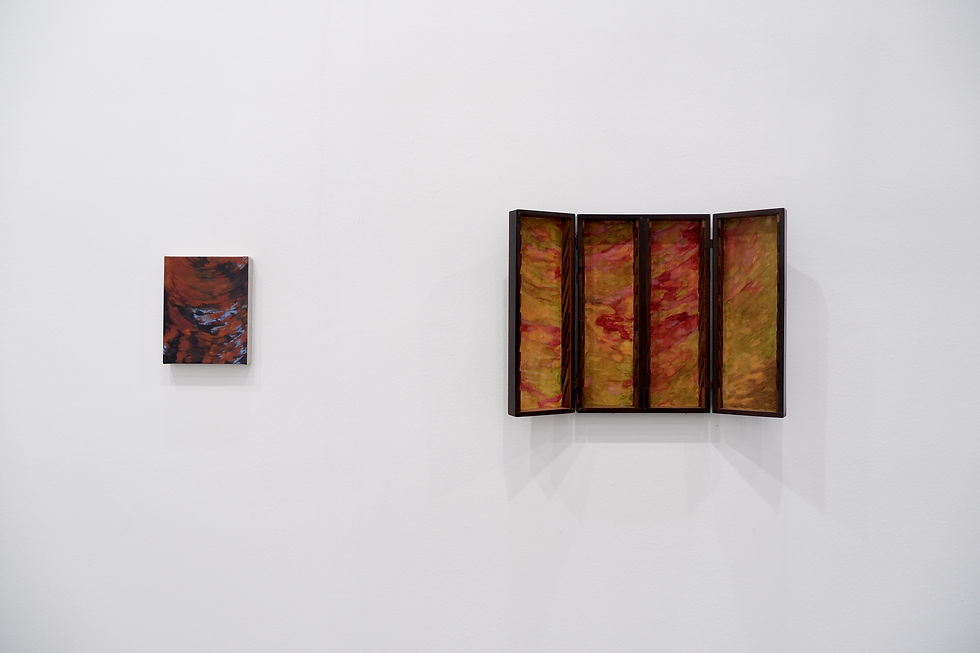
As part of miart 2026, Main Section, the Artopia gallery presents a dialogue between the artists Elena Mazzi (Reggio Emilia, 1984), Emma Moriconi (Milan, 1997) and Niamh O’Malley (Co. Mayo, 1975), whose practices, though articulated on different scales of action, reveal natural compositional affinities and thematic analogies. We are faced with vibrant works in which the adoption of processual elements drawn from a familiar landscape and microcosm or from a clinical and ‘objective’ grammar (O’Malley’s objets trouvés, Moriconi’s ultrasound scans and Mazzi’s maps) fuels a dialectic between opposing polarities. Contrasting forces seem to coexist within the same field of representation, visual and semantic counterpoints that, on the one hand, predispose us to a close encounter, and on the other, open up a reflective and powerful void, a closeness of gaze and body.
Niamh O’Malley’s “sculptural objects” oscillate between potential configurations and impermanence; they are the result of minimal actions that “hold things together”, moments of silent coexistence that evoke fragmented memories. O’Malley prefers assemblages that lean on and support one another in balance to more stable solutions. A paradoxical vulnerability and melancholy characterise her works, compelling the viewer to look beyond what is immediately apparent.
Elena Mazzi’s methodology, which draws on anthropology, adopts a holistic approach aimed at healing social divisions and restoring a balance between intimacy and community through observation and the integration of diverse skills. Her most recent works stem from a reflection on the new geopolitical and economic spaces in the Arctic regions. By blending ancient maps, motifs and symbols from local cultures, Mazzi creates new visions that recount the changes taking place in the landscape and in our relationship with it as a result of climate change.
Finally, Emma Moriconi’s canvases explore the tension between life and decay, between presence and absence; they are the result of interdisciplinary research that intertwines the body, as an emotional entity, with images of a medical-scientific nature (ultrasound scans of her reproductive organs and her mother’s heart) and give form to what lies beneath the surface, to the intricate and invisible structures that govern human and non-human life. The works reveal themselves through their materiality: the ripples of the raw jute canvas, set against smooth surfaces such as linen or wood, seem to mirror the different textures of the human body.